SAP Commerce On-Premise to CCv2
Part 1: The Why Before the How

Part 1: The Why Before the How
The key facts – worth reading before any decision is made:
This article lays out the landscape clearly, so informed decisions can be made.
Many enterprises still running SAP Commerce on-premise, the same question keeps surfacing in leadership conversations:“Are we going to regret not moving sooner?”
It’s the right instinct. But it’s not quite the right question. What’s needed first is a clear picture of the current position, the technical reality, the commercial implications, and the real options on the table. That’s what this article covers.
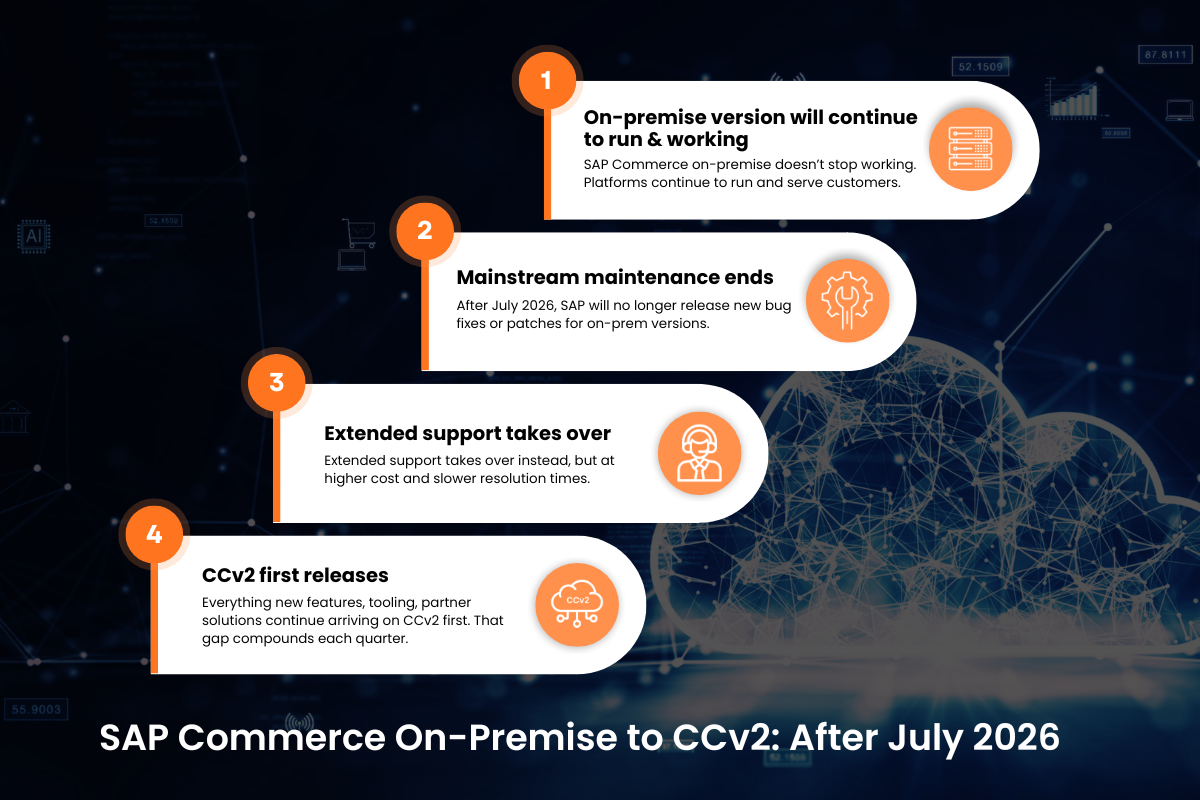
There’s been a fair amount of noise around this date. Here’s what it actually means in practice stripped of speculation.
Can on-prem still run after 2026?
Yes. But the risk and cost profile shifts meaningfully. Regulated industries in particular may face compliance or audit pressure. Leadership will need to make a conscious decision about whether to absorb that risk and manage it accordingly.
It’s easy to treat this as an IT infrastructure question. The commercial implications run deeper than that.
This is the most important distinction in the whole conversation. CCv2 changes where the platform runs. It doesn’t change how it was built over the years and that difference has significant cost and risk implications.
| What CCv2 Takes Care Of | What Remains in Scope |
|---|---|
| SAP-managed infra, patching, DR, scaling | Accumulated custom code and modified accelerators |
| Kubernetes deployment with CI/CD built in | Tight ERP integrations and the delays they create |
| Consistent dev / staging / production | Manual testing gaps and slow approval processes |
| Autoscaling that responds to real traffic | Legacy operating models that limit agility |
| Monitoring and observability out of the box | Technical debt — it doesn’t disappear in the cloud |
Cloud doesn’t hide complexity. It attaches a price tag to every inefficiency that’s been sitting unnoticed. That’s not an argument against migration, it’s the reason a clear-eyed assessment matters so much.
Vendor timelines aren’t the right benchmark. The more useful question is where the organisation stands today. The table below maps common situations to realistic planning windows:
| Situation | Likely planning window |
|---|---|
| Two or more SAP Commerce versions behind | 0–12 months |
| Compliance or audit pressure around support status. | 0–12 months |
| ERP coupling is driving most release delays. | 12–18 months |
| No clear internal owner for the CCv2 decision. | 12–18 months |
| Cloud cost predictability is a concern for finance. | 12–18 months |
| Recently upgraded. Platform stable and well-managed. | 18-24+ months |
This pattern comes up regularly in enterprise migrations. A team picks a timeline, plans around it, and moves. A few months after go-live, the uncomfortable questions start:
Table of Contents
 The Three Strategic Paths Forward and How to Choose
Scroll to top
The Three Strategic Paths Forward and How to Choose
Scroll to top