SAP Commerce On-Premise to CCv2
Part 1: The Why Before the How

Part 1: The Why Before the How
The three strategic paths forward and how to choose
Context from Part 1 SAP’s roadmap is CCv2-first. Staying on-prem remains an option but only if managed deliberately. The real risk is carrying hidden technical debt into cloud without understanding its scale. This article covers the three paths forward and the considerations behind each one.
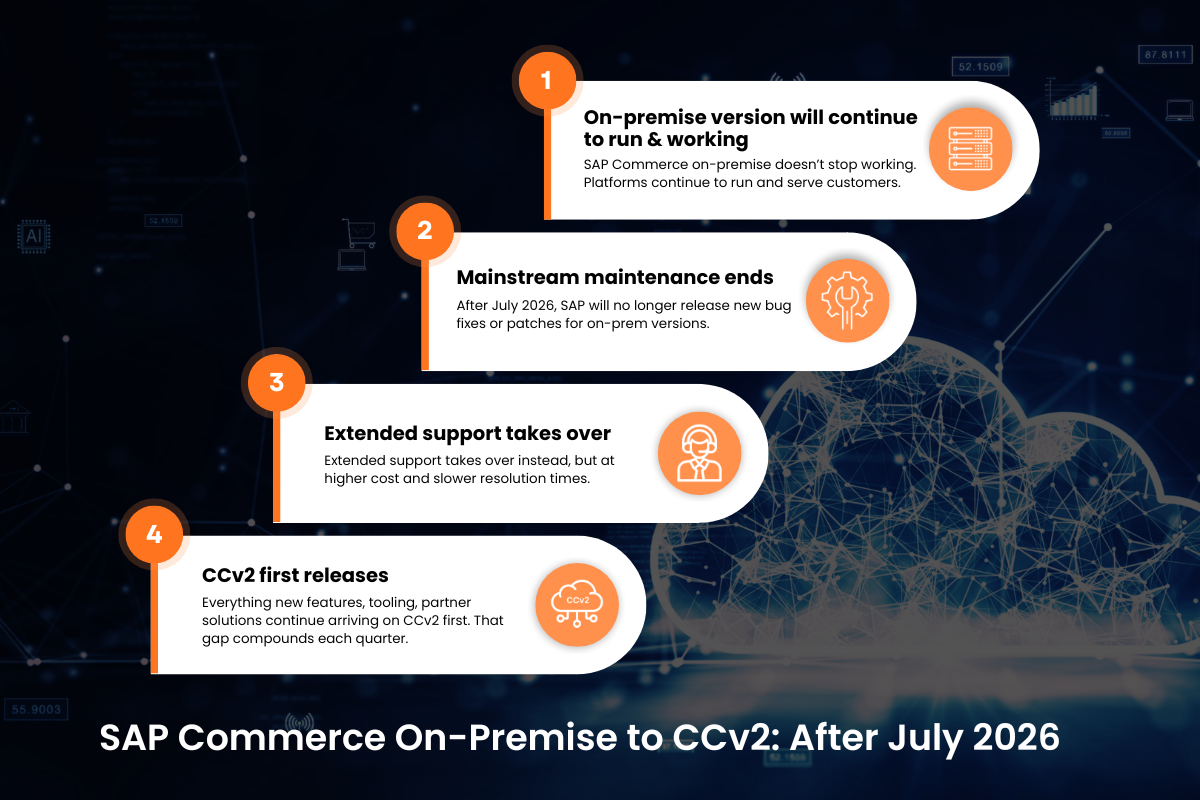
Before exploring the options, it’s worth being clear about what the post-2026 landscape actually looks like. This isn’t speculation, it’s where things already are:
The cost of inaction
On-premise doesn’t become impossible. It becomes progressively more expensive and risk-heavy, particularly without a structured plan. The longer the decision sits unresolved, the wider the gap becomes and the harder the eventual migration gets.
There’s no universally right answer. But there are three clear, defensible strategies. The right one depends on where the organisation sits today technically, commercially, and in terms of internal appetite for change.
This is not “do nothing and wait.” It’s an active strategy, one that requires real organisational discipline to execute well.
Best when: The platform is stable. Recent investments are still delivering value. The organisation has the discipline to upgrade consistently.
Watch out: “Stay” becoming “drift.” Unmanaged platforms accumulate debt fast and that debt becomes significantly costlier to deal with the longer it sits.
Move to cloud with minimal changes first. Secure the infrastructure and support benefits, then optimise from there.
Best when: Timelines are tight. There’s compliance pressure, infrastructure risk, or support deadlines driving the schedule.
Watch out: Assuming this is the low-cost route. It’s the fast route. Cloud will surface inefficiencies that weren’t visible before and those will need dedicated time and budget to resolve.
Address the underlying issues first. Arrive in cloud leaner, faster, and genuinely cheaper to operate long-term.
Best when: The organisation has time, executive sponsorship, and genuine appetite for broader change. A transformation programme is already underway.
The honest truth: This delivers the strongest long-term ROI by a meaningful margin. But it requires longer timelines, higher upfront investment, and board-level commitment.
| Stay & Upgrade | Lift & Shift | Value-Driven | |
|---|---|---|---|
| Speed to cloud | Slower | Fast | Medium |
| Upfront cost | Low | Medium | Higher |
| Long-term TCO | Medium | Medium-High | Lowest |
| Risk level | Low (if managed) | Medium | Medium |
| Exec buy-in needed | No | Minimal | Yes |
| Best for | Stable teams | Tight timelines | Transformation |
GoWide works with SAP Commerce organisations across all three paths. The role isn’t to push towards migration, it’s to ensure the decision made is the right one for the specific situation, and that execution is handled with full cost and risk transparency.
This isn’t about acting today. It’s about stopping the drift. Because inaction has a real cost and it’s one that most organisations don’t notice until it’s already compounded:
The organisations that navigate this well aren’t the ones that moved fastest. They’re the ones that moved with clarity, a grounded understanding of where they stood and a plan that could withstand scrutiny.
“What decision will we still be comfortable defending in five years?”
That’s the question that matters. GoWide’s obligation-free assessment is built to help answer it with real data, not assumptions.
Ready to move from uncertainty to clarity?
GoWide’s obligation-free assessment provides an independent, evidence-based view of CCv2 options purpose-built for decision-makers.
No pressure. No vendor agenda. Just a clear picture of the situation and the best path forward.
Book your free strategy call now: [email protected]
Table of Contents

 Scroll to top