Hybris to Spartacus Migration
How AI Reduced Migration Time by 70%
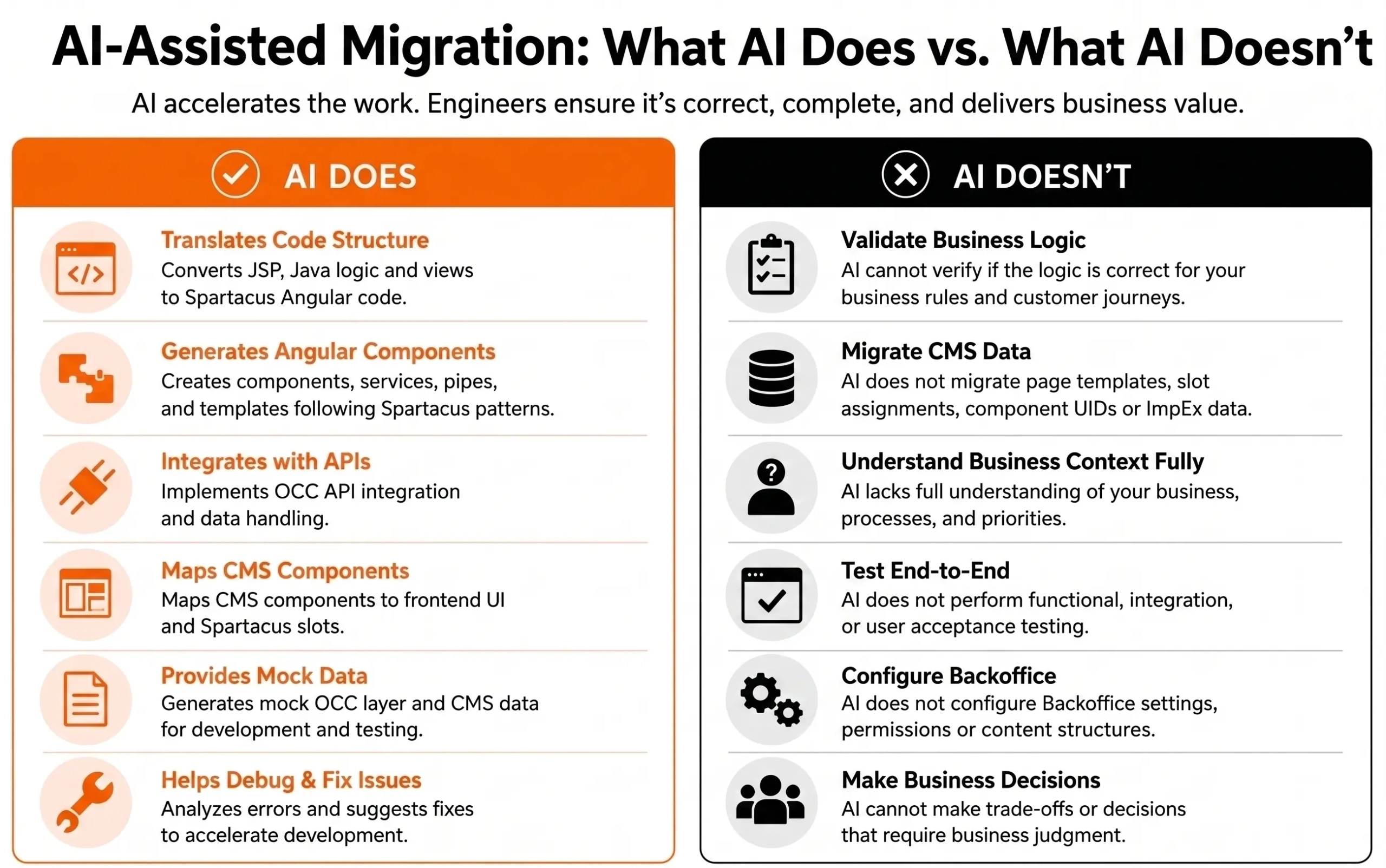
We took a real enterprise SAP Commerce storefront, including JSP templates, Spring MVC controllers, and LESS stylesheets, and migrated it to Spartacus Angular using the AI tool as a co-engineer. This article covers exactly what happened, what the AI got right, and where human expertise still matters.
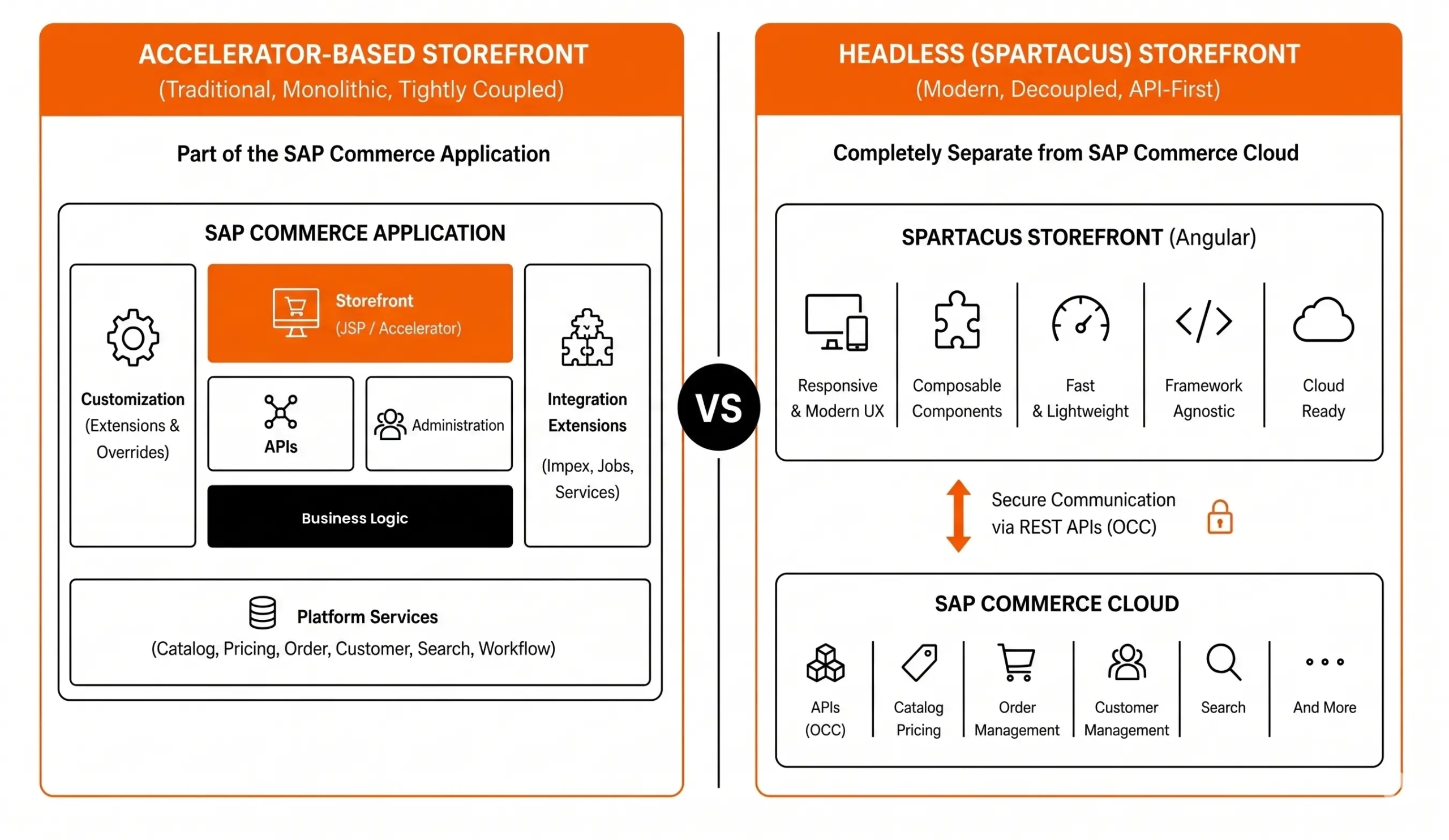
If you run a Hybris Accelerator storefront, you already know the conversation. SAP has stopped investing in JSP-based storefronts. Spartacus, the Angular Progressive Web App framework, is the mandated path forward. Your engineering team is staring down 300 to 800 JSP template files, dozens of Spring MVC controllers, and years of custom addon logic wondering how on earth to migrate all of it.
The industry answer has been: hire a team of dual-stack developers who know both Hybris internals and modern Angular, lock them in a room for 18 to 30 months, and write million-dollar cheques. That works, but it is brutally slow, brutally expensive, and brutally dependent on a shrinking pool of people who hold both skill sets.
A typical enterprise migration costs $3M to $8M and takes 18 to 30 months. We believed there had to be a faster way, and the good news is that there was one.
We decided to test a different hypothesis: what if an AI could do the heavy lifting of code analysis and generation, reducing the dual-stack knowledge requirement and dramatically cutting the time from JSP to running Angular?
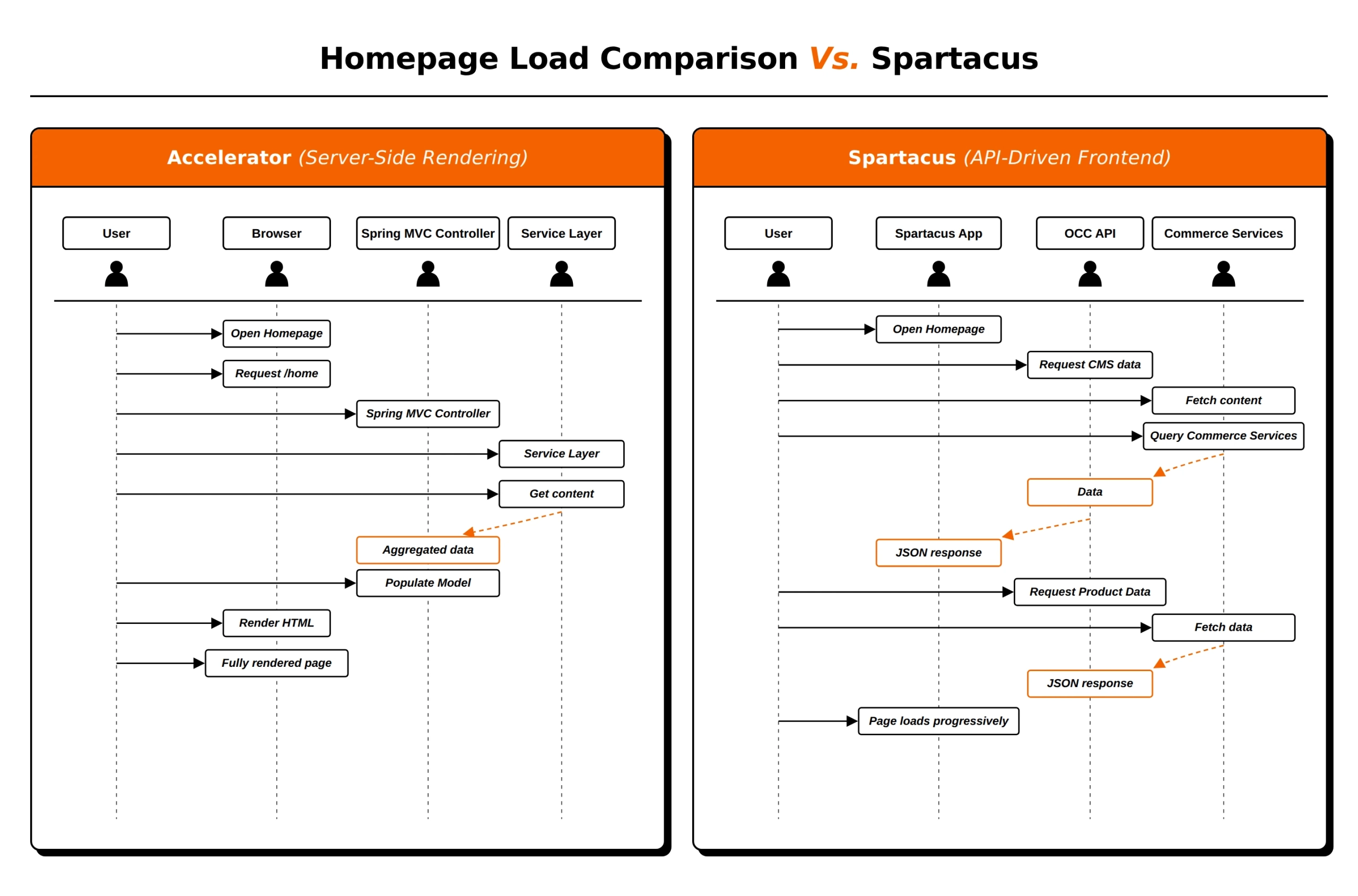
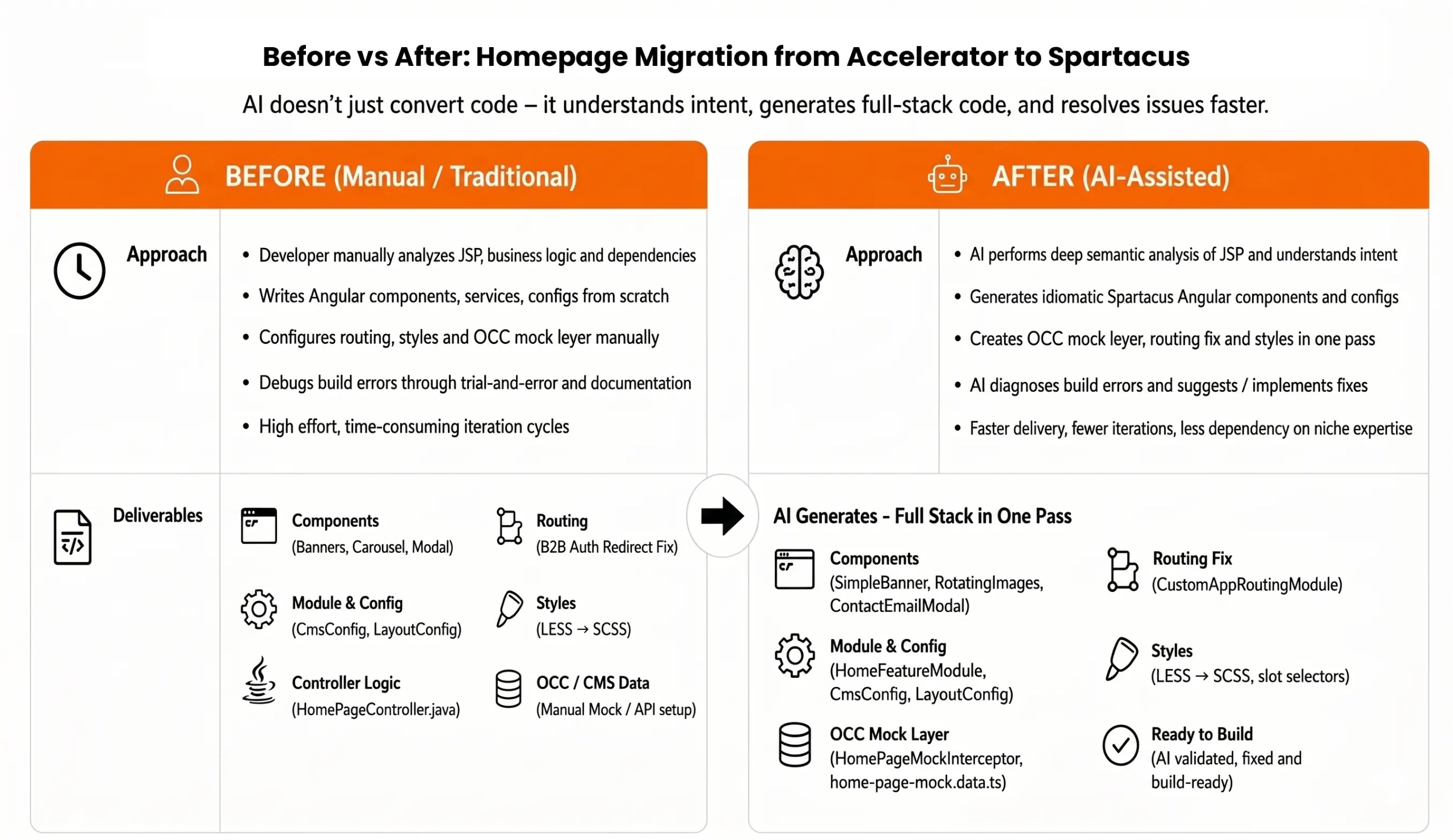
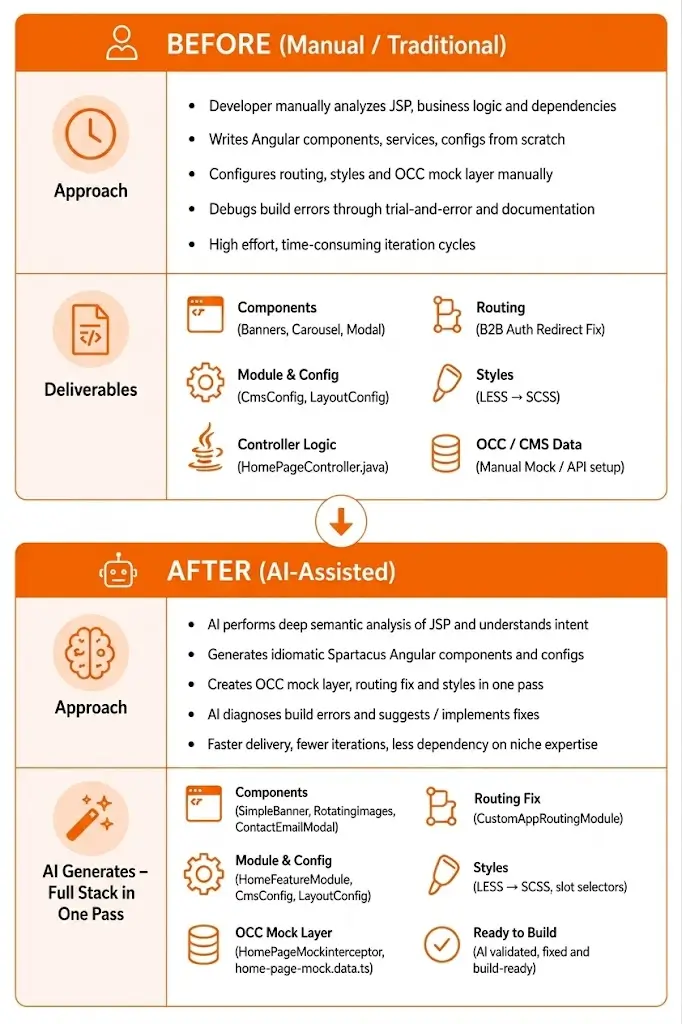
The first thing that surprised us was the depth of semantic analysis. The AI didn’t just convert JSP syntax to Angular syntax. It understood the intent of each construct and mapped it to the idiomatic Spartacus equivalent.
But what genuinely impressed us was the iterative debugging. When ng build threw errors, we fed them back to the AI and it diagnosed root causes that would have taken a senior developer hours to find.
| Error | Manual Diagnosis | AI Tool Diagnosis |
|---|---|---|
| NG6008: Component declared by 2 NgModules | Hunt through module tree manually | Identified stale home-wrapper.module.ts from previous iteration |
| NG6008: Standalone component in NgModule | Know Angular 19 changed the default | Added standalone: false to all 3 decorators immediately |
| SCSS mixin undefined at build time | Trace angular.json styles array | Identified double-import of @spartacus/styles/index |
| Homepage redirecting to /login (B2B mode) | Senior architect, 1–2 days investigation | Read channel: “B2B” from network tab, traced to defaultB2bOccConfig NgRx effect, generated CustomAppRoutingModule fix |
| SyntaxError: Unexpected token ‘<' at module import | Vite chunk resolution debugging | Identified featureModules dynamic import() returning HTML 404; switched to eager declarations |
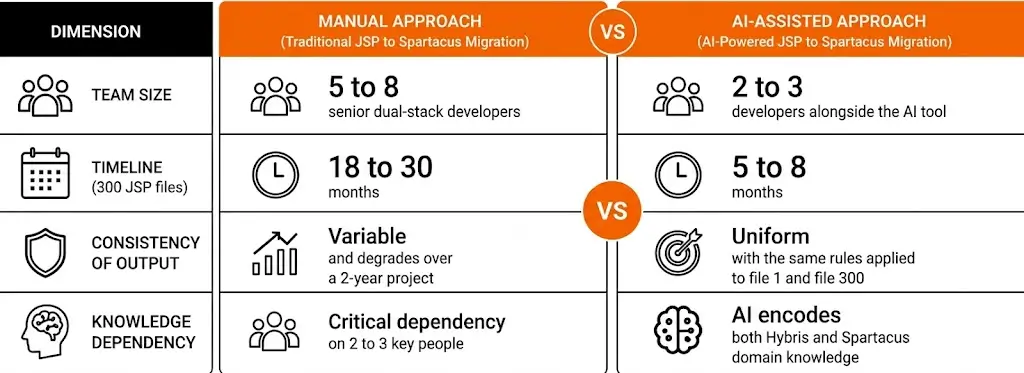
The homepage migration is a single data point, but it is a highly representative one that contained every category of challenge present in a full migration. Extrapolated to a 300-file enterprise implementation:
| Dimension | Manual Approach | AI-Assisted Approach |
|---|---|---|
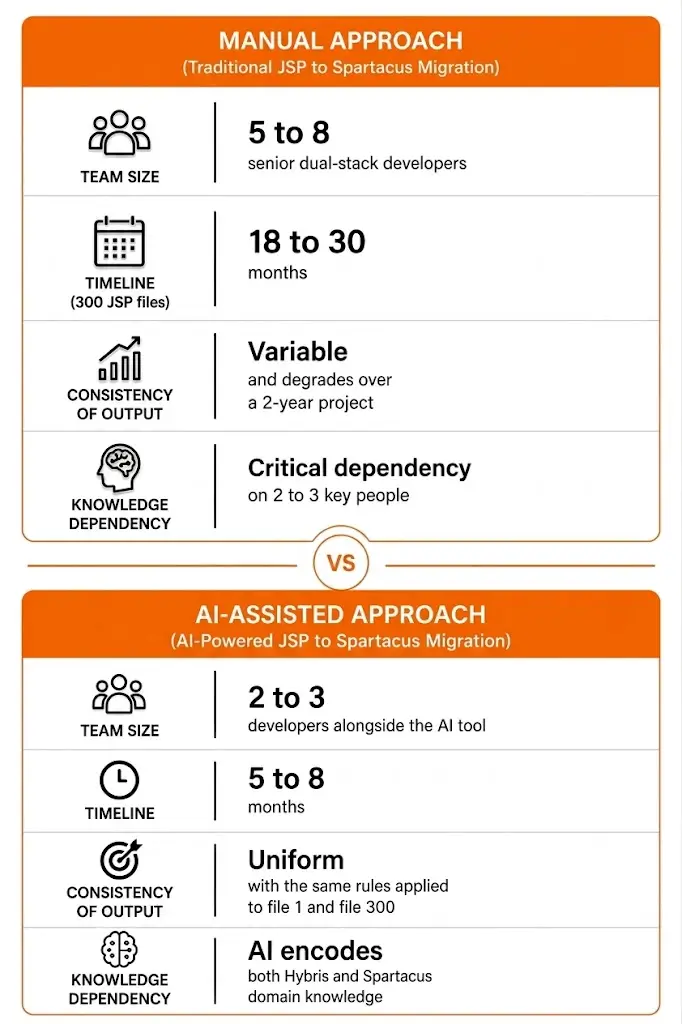
| Team size | 5 to 8 senior dual-stack developers | 2 to 3 developers alongside the AI tool |
| Timeline (300 JSP files) | 18 to 30 months | 5 to 8 months |
| Estimated cost | $3M to $6M | $800K to $1.5M |
| Cost per file migrated | $8,000 to $15,000 | $2,000 to $4,000 |
| Consistency of output | Variable and degrades over a 2-year project | Uniform, with the same rules applied to file 1 and file 300 |
| Knowledge dependency | Critical dependency on 2 to 3 key people | AI encodes both Hybris and Spartacus domain knowledge |
The AI tool does not just write code faster. It makes the knowledge portable. You no longer need a rare individual who knows both Hybris internals and modern Angular.
Weeks 1 to 2
AI-powered JSP parser generates a migration manifest JSON across all source files. Classify by page type and complexity. Export CMS metadata from Backoffice. Prioritise in the following order: Content pages, Category pages, Product Detail Pages, Cart, Checkout, and finally Account pages.
Weeks 3 to 12
Built for long-lived programs: secure engineering practices, predictable delivery cadence, and continuity that survives team changes.
Weeks 13 to 20
Replace mock interceptors with live OCC. Regression test against JSP output. Lighthouse profiling. Accessibility audit. Parallel-run JSP and Spartacus for A/B comparison before cutover.
Weeks 21 to 24
Traffic cutover. Monitor Core Web Vitals and conversion metrics. Decommission JSP infrastructure after stability period. Archive AI session logs as migration audit trail.
Every SAP Commerce customer will migrate to Spartacus. The JSP storefront end-of-investment is not a rumour. It is SAP’s stated product direction. The choice is not whether to migrate but how much it costs you in time, money, and engineering talent to get there.
Our experiment shows that AI-assisted migration is not a futuristic concept. It works today, on real codebases, with measurable results. The homepage migration which involved converting five source files into a complete, build-passing Spartacus feature module, happened in a single working session. The equivalent manual effort would have been two to three weeks of developer time.
At enterprise scale, across 300 to 800 files, that multiplier becomes transformational: a $4M to $5M cost saving, over a year removed from the timeline, and a smaller team able to execute a migration that previously required a cast of dozens.
Book your free strategy call today and let us show you what your migration could look like with AI working alongside your team. Reach us at [email protected] and we will get back to you within one business day.
Scroll to top