Microservices in SAP Commerce Cloud
Key features and how to Move Beyond Monolithic Architecture

Key features and how to Move Beyond Monolithic Architecture
Scalability and faster time-to-market are important considerations that have compelled many firms to choose microservices design for handling operations in SAP Commerce Cloud. Microservices Architecture in SAP Commerce Cloud is helping ecommerce businesses to effectively manage multiple aspects of operations by maintaining cost-efficiency and flexibility.
With constant evaluation of technical architecture patterns, CTOs have found microservice architecture a clear path to embracing e-commerce operations. Implementing this microservices architecture will lead to numerous benefits, including decoupled management, scalability, flexibility in choosing the right tech stack, and fault tolerance. However, thinking of a switch from a monolithic architecture is never an easy task. It necessitates careful planning and an understanding of bounded contexts and code responsibilities.
So, we are investigating the best practices for extending SAP Hybris’ features and capabilities by integrating microservices architecture through this blog.
Under the microservice design approach, the structures are coupled into self-contained units that are deployed and managed independently. Each service performs a business function within a comprehensive application ecosystem. The components will run independently without interrupting the other core parts through modular development that does not affect the entire system.
Unlike monolithic architecture, microservice allows communication through APIs, which ensures a cohesive, decoupled service. Operating on a flexible approach, this architecture is developed in any programming language, scaled as per individual demand, and maintains robustness while replacing or updating the data. These three categories of microservices architecture including:
Microservice in SAP Commerce Cloud enables developers to have independent responsibilities and decentralized data administration. Here are some common features of this architecture in the context of SAP Hybris:
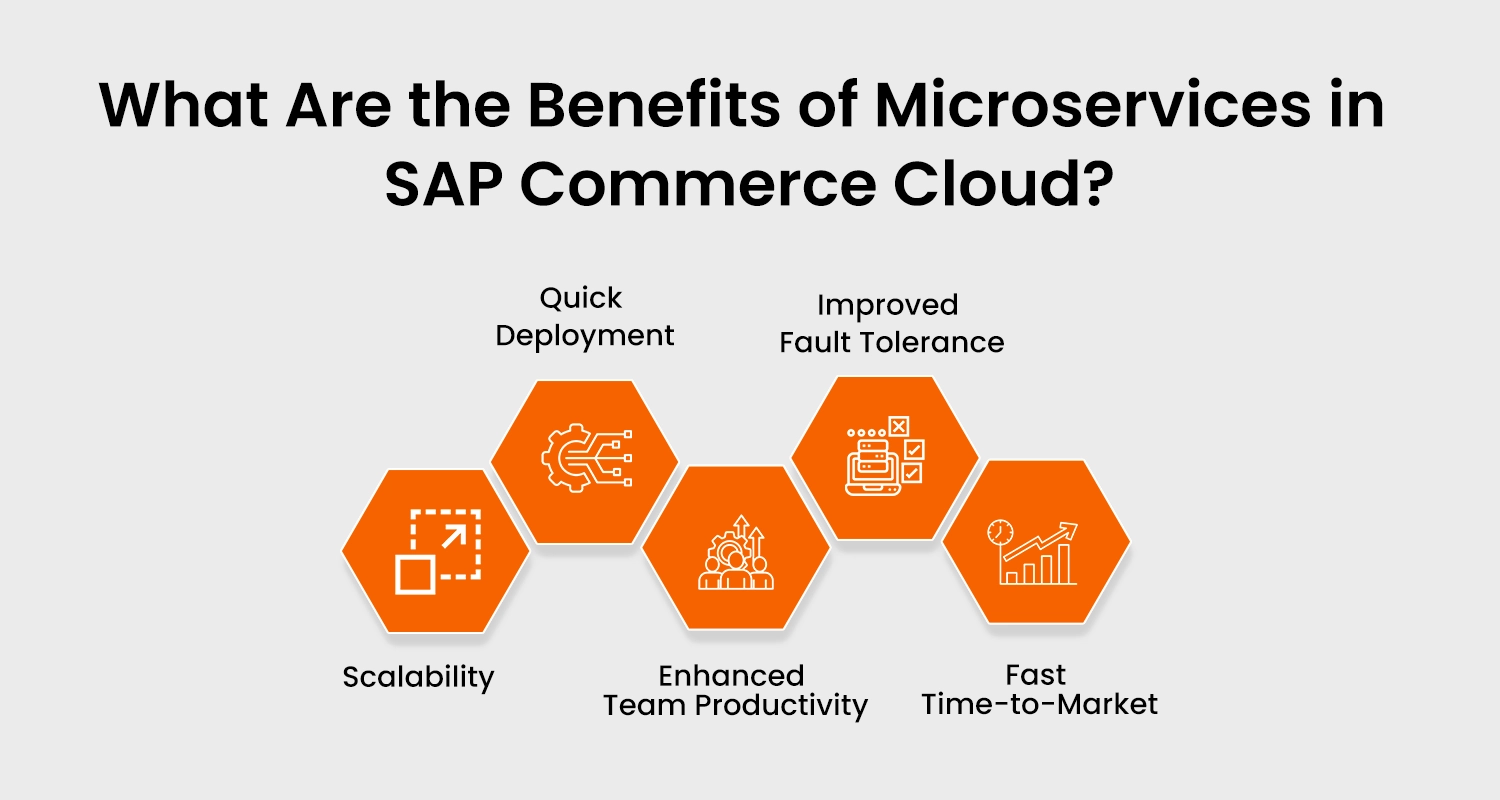
Compared to monolithic design, microservice architecture takes an agile approach to manage applications in modular components. Here are some prime benefits of using microservices architecture in SAP Commerce Cloud:
With domain-driven design, you can create boundaries between different domains, ensuring that each domain service is aligned with a business capability. This can help break down the e-commerce solution with a well-defined aggregate root that relates to the domain’s central object. For instance, in an order service, the aggregate root is order itself.
In software development, the SRP rule defines each class as having a single responsibility to alter. This can make the software more understandable and manageable. The modules need to be decoupled to increase the chances of forming a clear and concise interface. For instance, an e-commerce portal might have multiple services with single responsibilities that do not need to be integrated with one another as it will increase the complexity.
Microservice architecture’s core competency is decoupling services. SAP Commerce Cloud allows communication between two services through well-defined APIs such as RESTful and GraphQL. Since the services are loosely coupled, the changes in one system will impact others. You can implement API gateways to create a central point of communication for authentication and control service discovery.
There are synchronous and asynchronous communications in microservices. Asynchronous communication will occur at the fulfillment stage when the customer notification is processed. You need to maximize asynchronous communication where there is no dependency on other components, which increases the efficiency of the application.
One of the best practices in microservices is to store data in a separate database rather than a common database for monolithic architectures, which is a logical separation of data. This approach is regarded as decentralized data management, which allows users to have full independence of data storage. It will reduce latency and enhance the system’s security.
As already discussed, fault tolerance is the key advantage of microservices, which must be implemented correctly to eliminate potential service failures. You need to use circuit breaker patterns to avoid cascading failures. Also, you can disable non-critical functions when the dependent service is unavailable. Use a retry mechanism for failing services with exponential backoff.
Containerization and orchestration tools are best when it comes to managing the microservice architecture. In SAP Commerce Cloud, Docker is used for containerization and Kubernetes for orchestration, which can balance load and automatically scale services. These tools provide a way for consistently building and deploying services in whatever language they are coded in. These tools will also facilitate monitoring and logging tools, which substantially helps reduce the architectural complexity.
If you want your microservice architecture to function properly, consider using CI/CD pipelines, which are typically used for testing, integrating, and automating code releases. In order to reduce the risk of downtime, users can also employ blue-green deployment methodologies, which enable them to test the code in two settings. Use of some cloud-native technologies, such as SAP Hybris’s Kubernetes, can speed up deployments along with thorough testing.
In SAP Commerce Cloud, event-driven architecture will be the best approach for loosely coupling services. You can use message brokers like Kafka or RabbitMQ to leverage asynchronous communication. Ensure eventual consistency across data and use saga patterns to manage multiple transactions, keeping data consistency in place across services.
Monitoring and logging are the best practices for improving the high performance of microservices. Experienced developers will be required to detect performance errors by performing such activities. You can run periodic health checks on the services and trigger alerts when the service is down to avoid failed service requests.
Microservices architecture in SAP Commerce Cloud has the essence of modular and independent setups, and developers can gravitate towards patterns that can be complex in terms of SAP Commerce Cloud. Embracing the domain-driven design, asynchronous communication, data de-centralisation, and fault tolerance will make your infrastructure more suitable. Being a strategic enabler, microservices empower businesses to adapt, scale, innovate, and respond faster to customer demands by moving ahead from monolithic architectures.


 Process Mining vs. Traditional Business Analysis