AI Governance & Responsible AI
Frameworks, accountability, and risk, and how to govern AI inside SAP and your enterprise systems so you can scale it with confidence.

Frameworks, accountability, and risk, and how to govern AI inside SAP and your enterprise systems so you can scale it with confidence.
Most enterprises have stopped asking “which AI tool should we buy?” The harder question, the one that now reaches the board, is simpler to state and far more difficult to answer: how do we trust AI once it starts making decisions that matter?
That shift is happening across every regulated and asset-heavy industry. In one recent conversation, a supply chain leader at an aerospace components manufacturer put it plainly. The discussion was not about adopting more AI. It was about what happens when AI starts selecting suppliers, forecasting demand, planning inventory, and flagging risk. If the model rejects the wrong supplier and an aircraft part is delayed, who is accountable? The AI? The vendor? The CIO? The supply chain director? The CEO?
That question is the seed of modern AI governance, and it is not confined to aerospace. Healthcare, banking, energy, insurance, and government procurement are all wrestling with the same problem. The gap between what enterprises are deploying and what they can actually govern is the defining risk of this cycle.
This guide is written for the executives who own that gap: CIOs, chief data and AI officers, and risk and compliance leaders. It explains what AI governance is, why it has moved from a compliance footnote to a growth strategy, the frameworks you need to know, and, most importantly, how to govern AI where it is hardest to govern: inside your SAP and enterprise systems, where the decisions are real and the audit trail has to hold up. Throughout, we link to deeper resources on each topic and to the GoWide Applied AI solutions that put governance into practice.
AI governance is the system of policies, roles, controls, and oversight that an organisation uses to ensure its AI is transparent, accountable, and safe across its entire lifecycle. It is the difference between deploying AI and being able to stand behind every decision it makes.
It helps to separate three terms that are often used interchangeably.
Responsible AI is the outcome: AI that is used ethically, fairly, and safely, in line with your values and your obligations to customers, employees, and society. Responsible AI is the destination.
AI governance is the practice that gets you there: the operating model, the approval gates, the documentation, the monitoring, and the clear ownership of risk. Governance is how you make responsible AI real and repeatable rather than aspirational.
AI compliance is the narrower requirement to align AI use with specific regulations, standards, and internal rules. Compliance is necessary but not sufficient. An organisation can be technically compliant and still deploy AI it cannot explain or defend.
The clearest way to understand what governance has to deliver is to follow the chain that every major framework encodes, from the EU AI Act to the NIST AI Risk Management Framework to ISO/IEC 42001 to Saudi Arabia’s SDAIA principles:
The Chain of Dependencies
›
›
›
›
Read it as a sequence of dependencies. You cannot have accountability without transparency, because you cannot hold anyone answerable for a decision no one can explain. You cannot build organisational trust without accountability, because trust requires someone to be responsible when things go wrong. And you cannot safely scale AI without trust, because leaders will not put AI in charge of critical operations they do not believe in. Governance is the machinery that turns transparency at one end into safe adoption at the other.
We break this down further in our companion guide on what AI governance is and why it matters, and on the principles of responsible AI.
Three forces have converged to make governance the most urgent conversation in enterprise AI.
For years, enterprise AI mostly meant recommendations, dashboards, and back-office automation where a human checked the output. That is changing quickly. AI is now embedded in the systems of record, making or shaping decisions in procurement, finance, supply chain, quality, and customer operations. Agentic AI, where models do not just advise but act, takes this further. When an autonomous agent inside your ERP can raise a purchase order, reroute a shipment, or reject an invoice, the stakes of a wrong decision change entirely. Governance is what keeps autonomy inside safe boundaries.
AI is no longer a lightly regulated space. The EU AI Act is now the world’s first comprehensive AI law, with real penalties. National regulators from the United States to Saudi Arabia to the UAE have published binding data rules and AI expectations. Standards bodies have produced certifiable frameworks. Being unable to demonstrate governance is becoming a commercial liability: enterprise buyers increasingly ask their vendors for evidence of AI governance before they sign, and procurement questionnaires now include it as standard. We cover the specifics in the regulatory frameworks section below.
This is the point that matters most to the business. The bottleneck on enterprise AI is no longer the technology. It is trust. Organisations stall not because the models do not work, but because leaders are not confident enough to let AI run critical processes. Governance removes that constraint. Done well, it is not a brake on AI, it is the enabler that lets you scale it. That is why the leading firms now describe responsible AI as a growth strategy rather than a compliance cost.
The market reflects this. Gartner estimates AI governance platform spend near 492 million dollars in 2026, in a category growing at roughly 36 percent a year. The demand is real because the pain is real.
Effective AI governance rests on six interconnected priorities. Think of them as the components you have to stand up, not a linear checklist. Each links to a deeper resource.
The McKinsey approach deals with three main dimensions, namely strategy and leadership, capabilities and structure, and culture and mindset. The priorities of this framework are the value of the commitment of the CEO, as well as cross-functional cooperation. It offers an in-depth evaluative approach that assists companies to realize the available opportunities of transformation and come up with a roadmap of implementation.
The MIT framework focuses on digital business strategy, business processes as well as digital infrastructure. It focuses more on combining digital activities with physical ones to build new business models. This is a very practical framework that may be useful in the manufacturing and industrial organizations, which are aiming at introducing the Industry 4.0 solutions.
01
Show when AI is used, what data shaped a decision, and why a model reached its recommendation. Its enabler is Explainable AI (XAI), the methods that let a human trace an output. Explainable AI for enterprise decisions.
02
The framework promoted by Accenture is human-centric transformation because it proposes workforce transformation in conjunction with the adoption of technology. It has five major pillars namely, experiences, insights, platforms, predictability, and people. This model is specifically very effective in tackling culture change and employee engagement.
The framework of BCG is about the speed of digital change enabled by flexibilities and partnerships in the ecosystems. It focuses both on speed and scale enabling organizations to fast-track the transformation agenda and streamline the risk aspect.
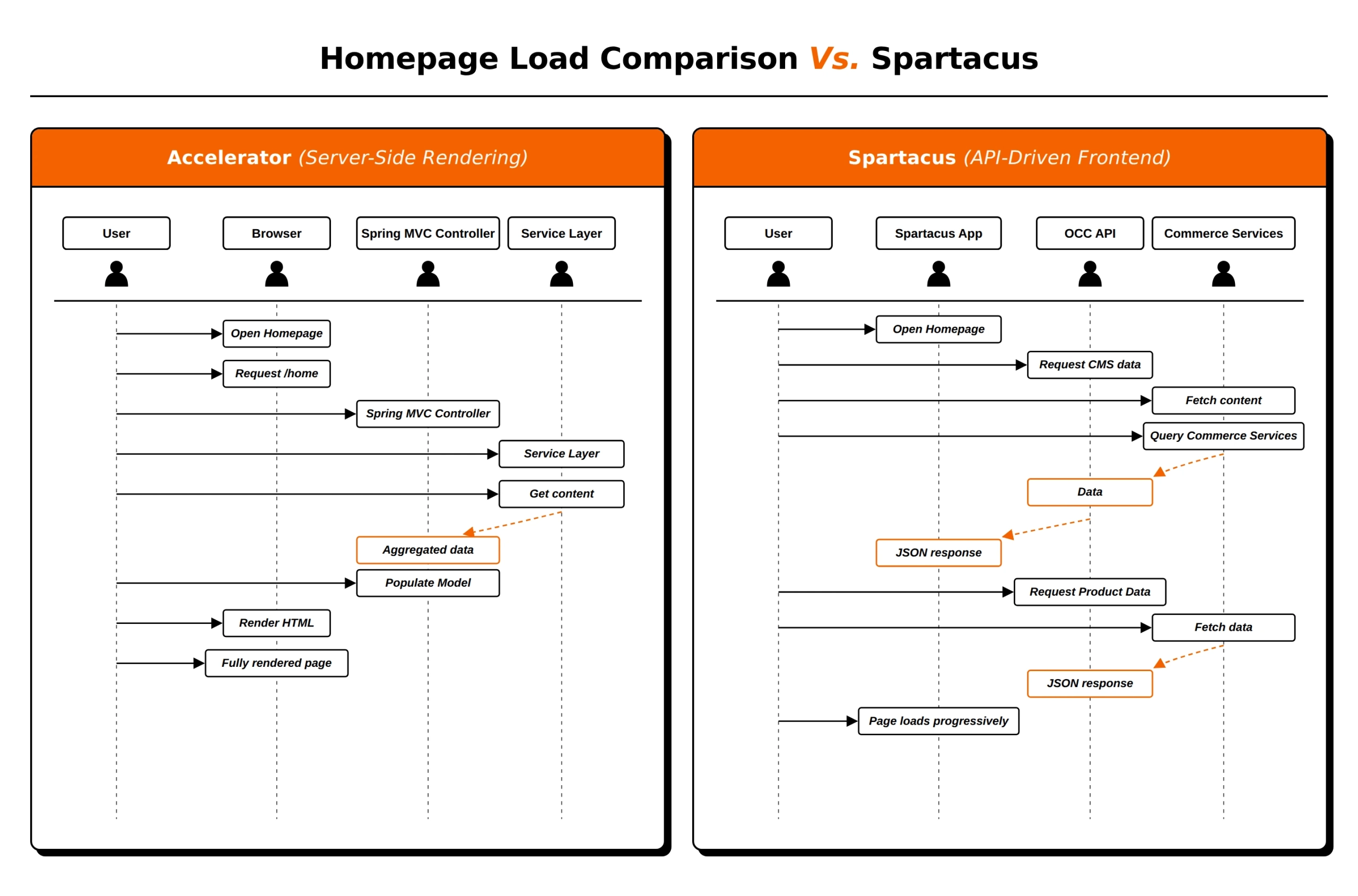
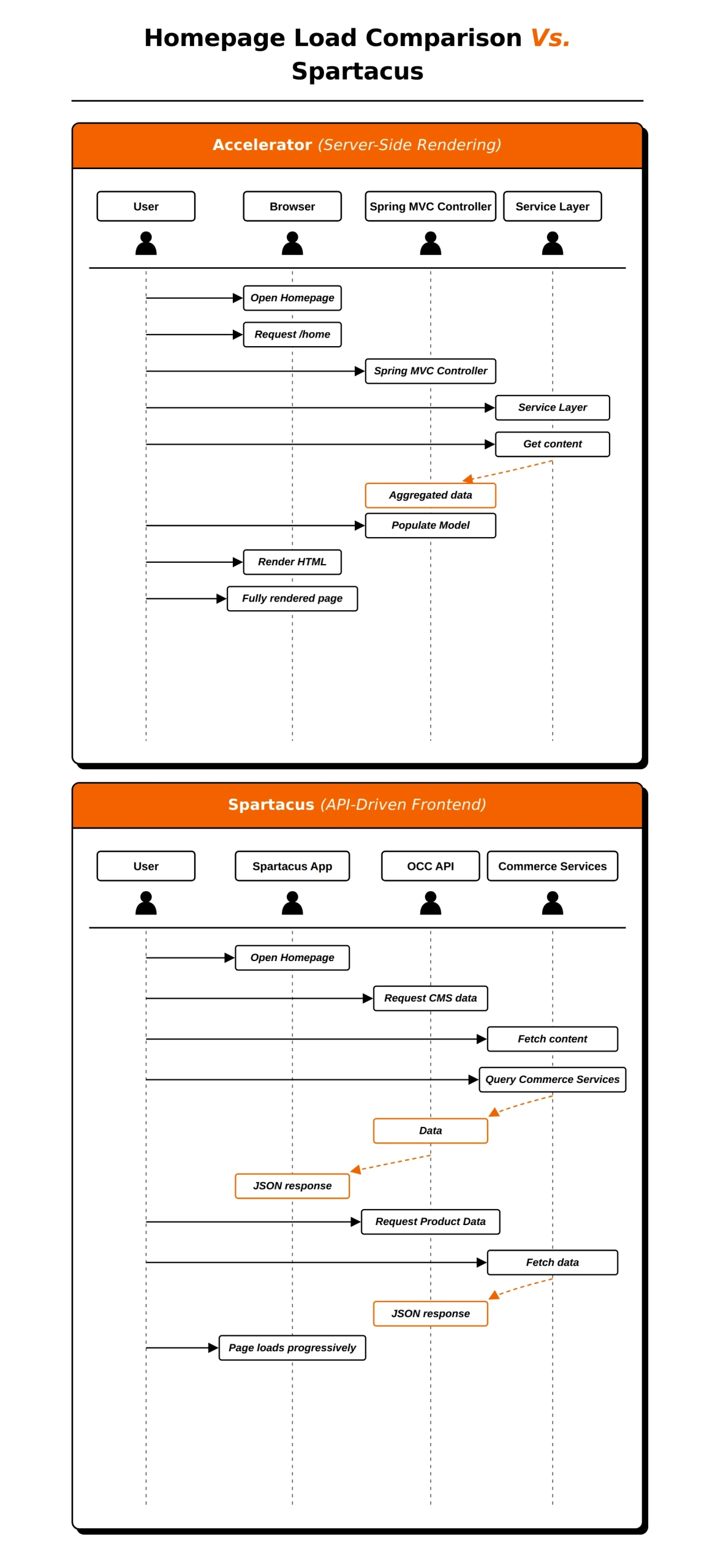
Migrating the homepage from SAP Commerce Cloud Accelerator to Spartacus uses AI-assisted analysis to extract UI intent from JSPs and map it to API-driven Angular components.
What the AI did
The first thing that surprised us was the depth of semantic analysis. The AI didn’t just convert JSP syntax to Angular syntax. It understood the intent of each construct and mapped it to the idiomatic Spartacus equivalent.
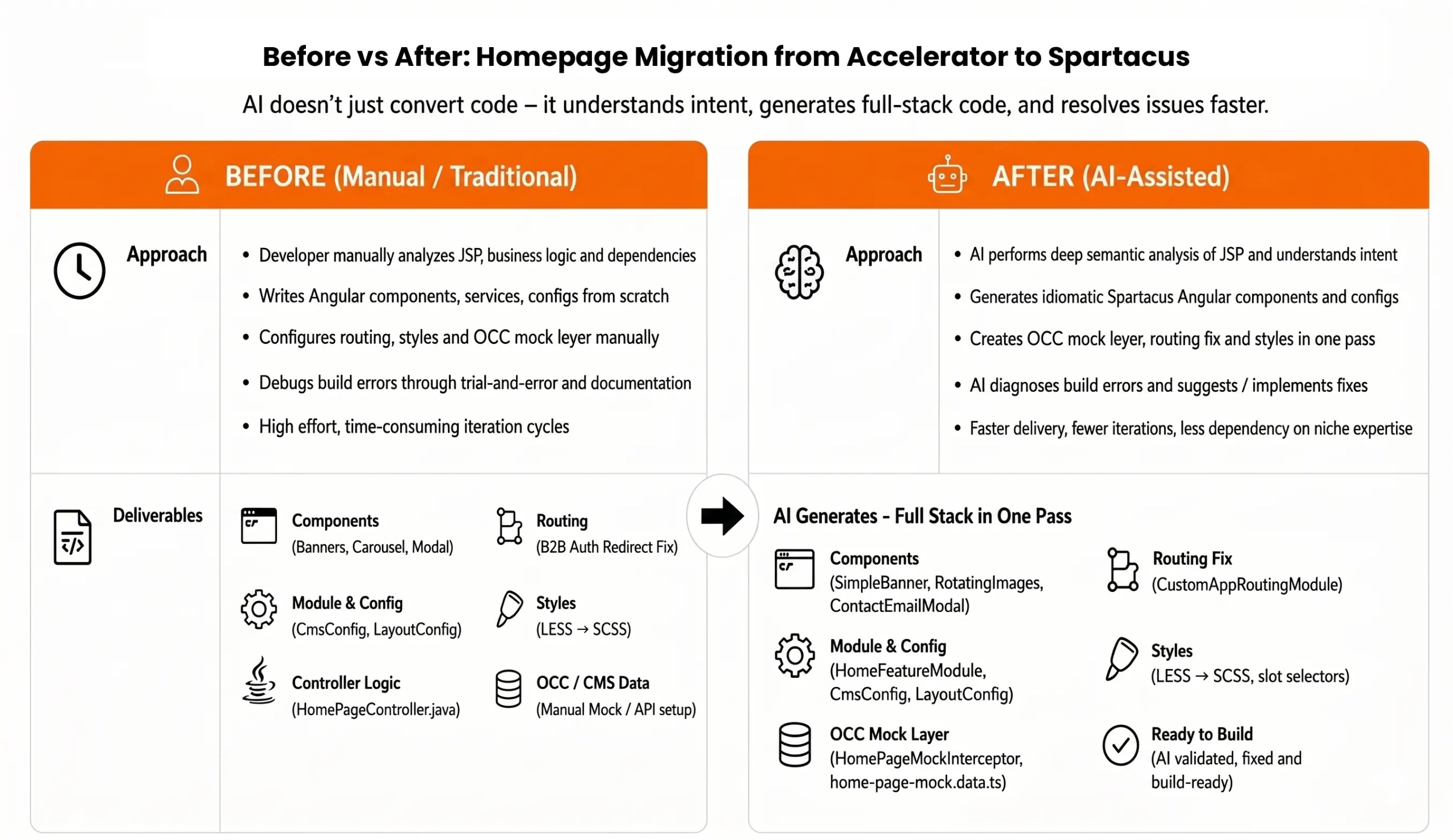
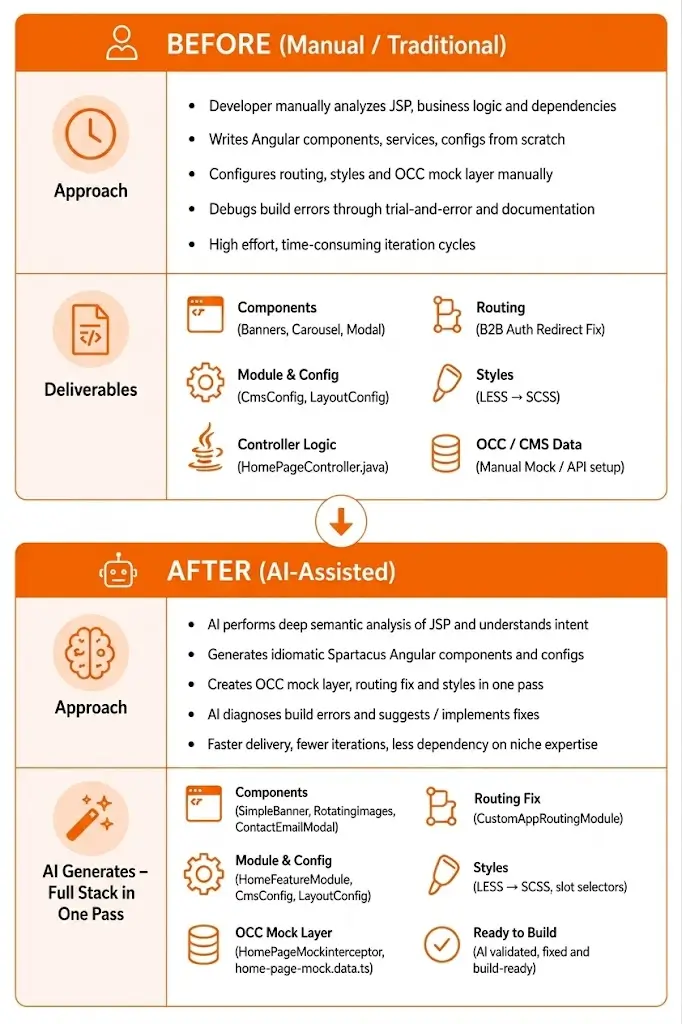
But what genuinely impressed us was the iterative debugging. When ng build threw errors, we fed them back to the AI and it diagnosed root causes that would have taken a senior developer hours to find.
| Error | Manual Diagnosis | AI Tool Diagnosis |
|---|---|---|
| NG6008: Component declared by 2 NgModules | Hunt through module tree manually | Identified stale home-wrapper.module.ts from previous iteration |
| Identified stale home-wrapper.module.ts from previous iteration | Know Angular 19 changed the default | Added standalone: false to all 3 decorators immediately |
| SCSS mixin undefined at build time | Trace angular.json styles array | Identified double-import of @spartacus/styles/index |
| Homepage redirecting to /login (B2B mode) | Senior architect, 1–2 days investigation | Read channel: B2B from network tab, traced to defaultB2bOccConfig NgRx effect, generated CustomAppRoutingModule fix |
| SyntaxError: Unexpected token ‘<' at module import | Vite chunk resolution debugging | Identified featureModules dynamic import() returning HTML 404; switched to eager declarations |
The AI didn’t just translate the code, it understood this business rule and rebuilt it in the new Spartacus setup so the user experience remained exactly the same.
The Numbers
The homepage migration is a single data point, but it is a highly representative one that contained every category of challenge present in a full migration. Extrapolated to a 300-file enterprise implementation:
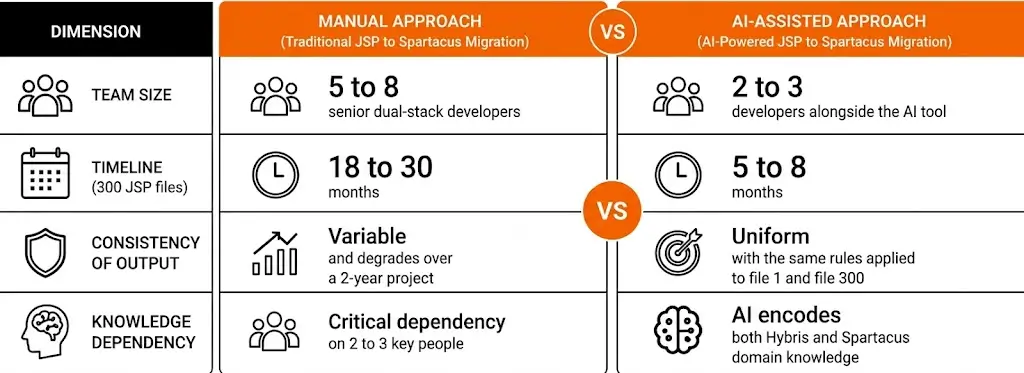
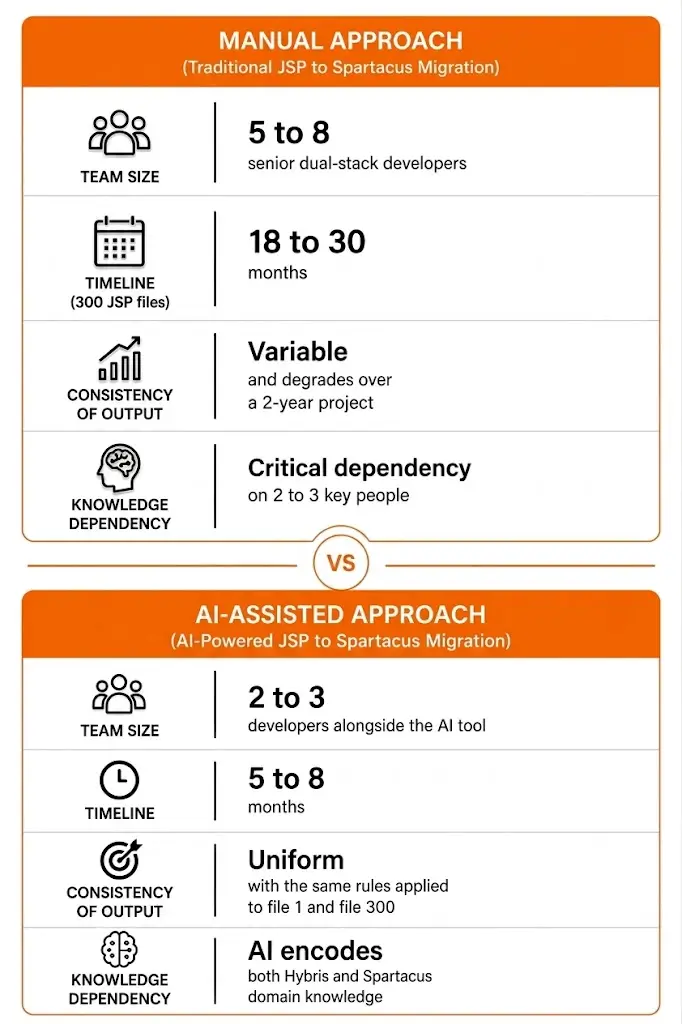
The AI tool does not just write code faster. It makes the knowledge portable. You no longer need a rare individual who knows both Hybris internals and modern Angular.
Honest Assessment
We want to be precise about this, because the hype cycle does nobody any favours. AI-assisted migration is not autonomous migration. It is a powerful accelerator that still requires qualified engineers at the wheel.
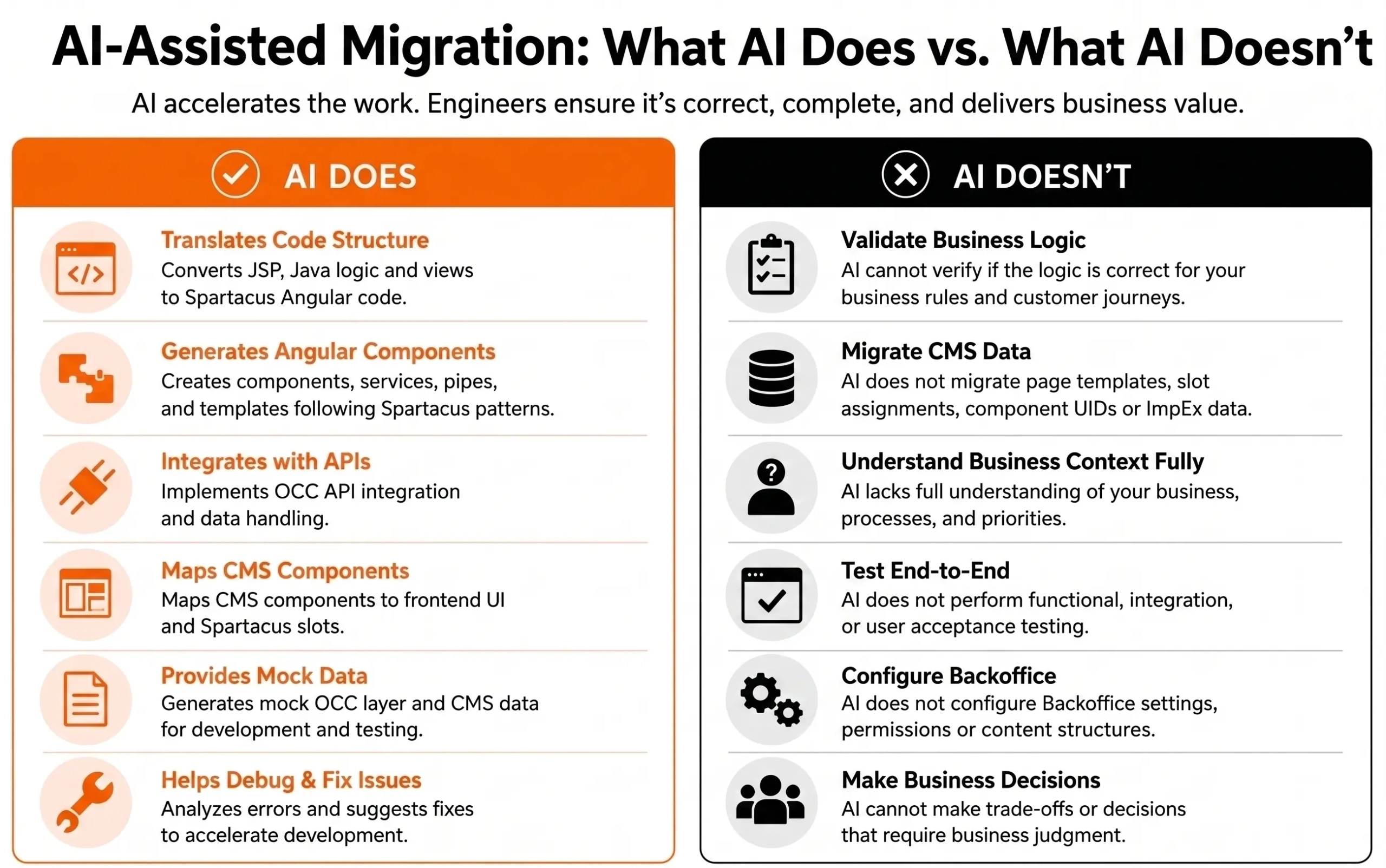
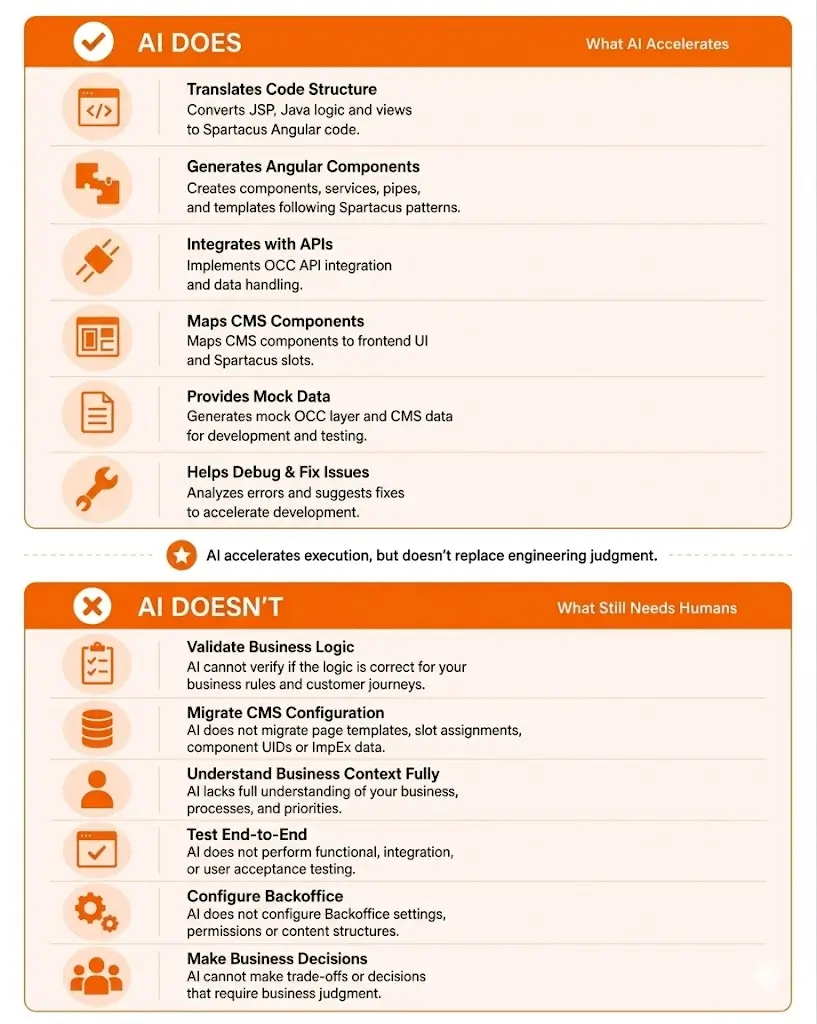
Instead of spending time coding each component, teams focus on assurance and alignment with business needs. The result is a 4–5x improvement in developer productivity, delivering faster outcomes while maintaining control and quality.
How to Do It
AI-powered JSP parser generates a migration manifest JSON across all source files. Classify by page type and complexity. Export CMS metadata from Backoffice. Prioritise in the following order: Content pages, Category pages, Product Detail Pages, Cart, Checkout, and finally Account pages.
Feed JSP files and CMS metadata to AI in page-type batches. AI generates Angular components, NgModules, CmsConfig, LayoutConfig, and mock interceptors. Developer reviews, runs ng build, feeds errors back for correction. Repeat until green.
Replace mock interceptors with live OCC. Regression test against JSP output. Lighthouse profiling. Accessibility audit. Parallel-run JSP and Spartacus for A/B comparison before cutover.
Traffic cutover. Monitor Core Web Vitals and conversion metrics. Decommission JSP infrastructure after stability period. Archive AI session logs as migration audit trail.
This approach streamlines migration by using AI to handle repetitive development tasks while teams focus on validation and business alignment. It delivers faster time-to-market, improved efficiency, and a controlled transition to a modern, scalable storefront.
Bottom Line
Every SAP Commerce Cloud customer will eventually move to Spartacus. The shift away from JSP storefronts is a clear product direction from SAP, so the real decision is not if you migrate, but how efficiently you do it in terms of time, cost, and engineering effort.
Our experiment shows that AI-assisted migration is already practical. A real homepage consisting of five source files was converted into a fully working Spartacus feature module in a single session, compared to the two to three weeks typically required with a manual approach.
At enterprise scale, across hundreds of files, this impact becomes significant: reduced timelines by months, substantial cost savings, and the ability for smaller teams to deliver what previously required large, specialized groups.
Book your free strategy call today and let us show you what your migration could look like with AI working alongside your team. Reach us at [email protected] and we will get back to you within one business day.